

 TH
TH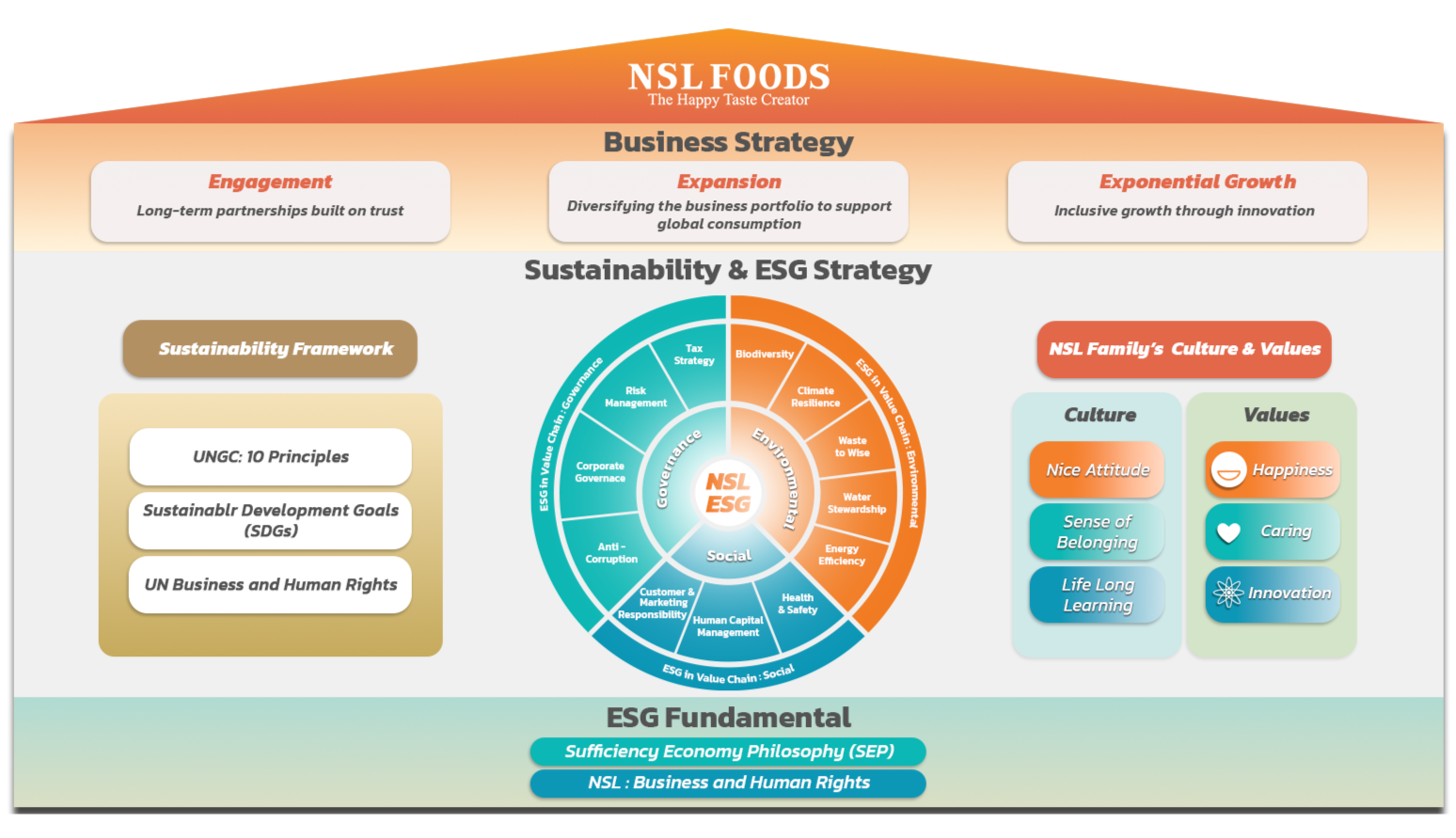
NSL Sustainability Strategy Towards 2030
NSL has defined its sustainable growth strategy towards 2030, encompassing all three dimensions of
sustainability—economic, social, and environmental—which are fully integrated into the Company’s and its
subsidiaries’ business operations.
The strategy also focuses on cascading policies and best-practice guidelines to stakeholders across the entire
value chain, both domestically and internationally, to ensure consistent implementation in alignment with the
Company’s corporate vision, “The Happy Taste Creator.”
NSL’s organisational driving strategy is centred on sustainable growth under the “3Es” framework, namely:

Enagagment
Strengthening strategic partnerships with customers to their full potential, while jointly advancing product and service development to achieve sustainable growth together. The Company places strong emphasis on the creation of long-term joint business plans, including collaborative product development initiatives. One example is the hot-toasted sandwich range, co-developed with CP ALL, delivering quality and convenience to over 1.2 million consumers daily.

Expansion
Delivering value across the Thai food industry towards becoming a sustainable global food manufacturer. NSL actively creates opportunities to expand into international markets through diversified sales channels, exporting a wide range of value-added food products. These include traditional Thai desserts in retort packaging, ready-to-eat retort rice bars, snacks, crispy coconut rolls in various flavours, as well as beverages and coconut-based products such as coconut water and coconut milk.

Exponential Growth
Growth built upon the foundation of an innovation-driven organisation, through the promotion of product development and research using food science and advanced manufacturing technologies, in order to respond to changing consumer needs. This includes the delivery of products and services as new alternatives, such as health-oriented products, Food Solutions, and Food Service products that are designed to meet customer requirements, leading to the creation of added value and the enhancement of market competitiveness for customers and business partners, thereby generating new outcomes for the Thai food industry.
The implementation of the 3Es strategy is built upon the Company’s ESG foundation.
Foundation:
The Company conducts its business in accordance with good corporate governance principles, with transparency and respect for human rights, and integrates the Sufficiency Economy Philosophy into its operations. In addition, the Company adopts international frameworks to promote organisational sustainability at a global level, such as the United Nations Global Compact (UNGC) Ten Principles, in alignment with the Sustainable Development Goals (SDGs), contributing to positive global change.
The Company has also established a sustainability driving strategy under the framework of NSL ESG in the Value Chain.

Environmental Dimension

Energy Efficiency
The company strives to reduce energy consumption across all production processes by improving energy efficiency and promoting the use of renewable energy to support the reduction of greenhouse gas emissions in line with global targets.

Water Stewardship
The company manages water resources sustainably by minimizing water usage in production processes, reusing water, and preventing adverse impacts on communities and ecosystems.

Waste to Wise
The company emphasizes waste reduction in production by applying circular economy principles such as recycling, efficient waste management, and developing products that minimize environmental impact.

Climate Resilience
The company prepares for the impacts of climate change by assessing risks and opportunities and adapting operations to align with sustainable development goals.

Biodiversity
The company promotes biodiversity conservation through sustainable management of raw materials and production areas, collaborating with communities and external organizations to protect ecosystems.


Health and Safety
The company prioritizes the health and safety of employees and stakeholders throughout the value chain by enhancing safe working environments, promoting a culture of safety, and strictly adhering to international standards.

Human Capital Management
The company is committed to strengthening human capital by developing employee skills and potential, fostering equality and diversity in the workplace, and creating an environment that promotes happiness and quality of life for employees.

Customer and Marketing Responsibility
The company conducts business responsibly toward consumers and the market by focusing on developing high-quality, safe products and communicating transparently and honestly to build trust and sustainably meet customer needs.
Governance Dimension

Anti-Corruption
The company conducts business transparently and adheres to ethical principles, supported by a clear anti-corruption policy. It promotes a transparent corporate culture and encourages stakeholder participation in preventing corruption.

Risk Management
The company employs comprehensive risk management strategies, including the evaluation of environmental, social, and economic risks. This approach ensures readiness and adaptability to changes in all circumstances.

Corporate Governance
The company strives to strengthen human capital by developing employee skills and potential, fostering equality and diversity in the workplace, and creating an environment that promotes happiness and quality of life for employees.
Tax Strategy
The company strictly complies with tax laws and maintains a transparent and fair tax policy to support sustainable economic and social development.
 About NSL
 Our Business
 Products
 Investor Relations
 Corporate Governance
 Sustainability
 Careers
 News
News